Sunday, September 22, 2013

A Spring Week on the Farm

Spring has arrived, and along with it the unpredictable spring weather.  But all is forgiven because spring is the season that brings the incredible transformation in the landscape from the quietness of winter to an explosion of life and colour.  We've already experienced the highs and lows of spring with days of summer-like heat and spring snow, wind-swept days and still, misty days.  And throughout it all the spring flowering plants produce their vibrant colours and make us happy.

The Road to Swallows Nest - a misty spring day
Spring snow on the driveway at Swallows Nest Farm
Spring afternoon sunlight among the Leucadendrons
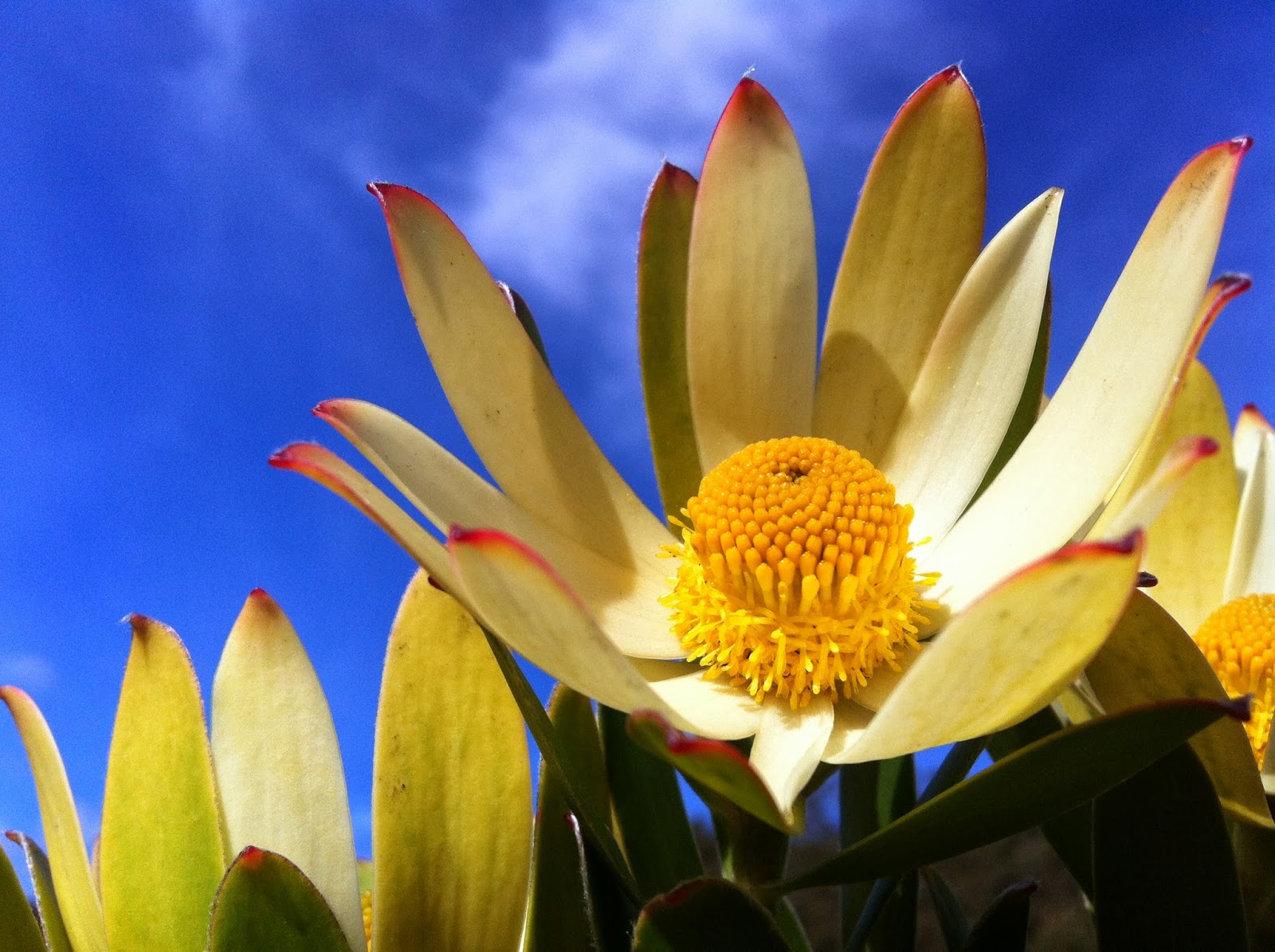
This week on the farm I've been picking a variety of spring flowering plants.  Leucadendron Gandogeri are a cheery yellow leuco that are flowering now.  We planted our first Gandogeri 3 years ago and are just starting to get good quantities of really lovely blooms.  Leucadendrons are such a diverse group of plants.  These Gandogeri have almost a daisy-like appearance when flowering.

Leucadendron Gandogeri
I've also been picking Waratah this week.  They were already beginning to bloom when the snow hit last week and some of them have a little discolouration damage, which is a pity.  They have definitely exceeded my expectations though and I'm pretty happy with them considering what they've been through!

Waratah waiting to go in the cold room
The other thing I've picked this week has been the Berzelia or Button Bush.  This is a gorgeous South African plant that's not a protea but has similar growing requirements.  I just love it - such a special plant!  We grow Berzelia Lanuginosa a Swallows Nest.  It has little clusters of balls of flowers on the end of sturdy stems.  The little balls begin green and as they get closer to flowering become creamy white until the tiny flowers burst out and make the little balls appear like fluffy white pompoms.  They are a great flower for weddings, and I have a couple coming up so they'll be put to good use.

Berzelia Lanuginosa
The Richea Dracophylla has been so busy producing flowers this year, and it takes the spring snow in its stride.  It's native habitat is the slopes of Mt Wellington and similar mountain slopes in Tasmania.  It is well adapted to coping with the extremes of the Tasmanian spring weather.  There are so many buds on some of the plants and I've been picking them early, trying to find the optimal time to pick that gives them the longest flowering time off the bush.

Richea Dracophylla
Today marks the spring or vernal equinox, when the day and the night are equal in length.  From now on, there will be more day than night, until just before Christmas and the summer solstice. Its a busy time on the farm with all the spring and early summer flowering plants, and the busyness of calendar events too.  Its lovely to have the longer days and the lengthy twilight.  They make me feel relaxed, as if I have all the time in the world.

Well, that's my spring week on the farm.  I'll leave you with a photo of tonights equinox sunset!


Thursday, September 12, 2013

Spring Snow!


Spring weather is predictably unpredictable here is Tasmania, and after beginning with summer-like weather in the first week of September, we've had snow this week.  Its the first real dump of snow in around 8 years at Swallows Nest Farm.  Thankfully I think the plants will cope okay, although many of the branches were bowed down under the weight of the snow.  


Most of the Safari Goldstrikes have been harvested - if they hadn't been I imagine they would be bent over like the plants beside them.


Pink Ice ... literally.


Maui Sunset and Tall Red bending over with the weight of the snow.


The Tall Red is nearly finished flowering.


Safari Sunset acted as little cups, catching snow and ice.


The Waratahs were a little early this year.  I'm not sure how they'll cope with the snow!


The kids had a lot of fun making snowmen and having snowball fights this morning - it was a memorable day on the farm!


Sunday, September 8, 2013

The Swallow's are Back!


Spring has arrived!  And, like clockwork, the swallows have returned. Two days before the beginning of the official calendar springtime, I woke to hear swallows chirping outside my bedroom window.  They had returned to last years nest under the eaves.  And flower-wise, spring has begun early here at Swallows Nest.  Some of our spring bloomers are already in full swing.  


The Maui Sunsets have begun to really glow in the last week.  I just love these Leucadendrons! 


Even the waratahs have begun to bloom.  They are around a fortnight earlier than they were last year with the Telopea Speciosissima being the first to flower.  I love using these flowers and I'm looking forward to the creative possibilities of using them for a spring wedding or two!


In this bunch you can see some of the newly blooming spring flowers I've picked this week -  *Leucadendron Gandoggeri which are beautifully papery and will continue to lighten until they are a clear bright cream.  *Telopea Speciosissima which are lighter if you pick them early, with a rosy pink colour and a beautiful rounded shape.  *Berzelia or Button Bush which are still green but will change as they flower to a soft fluffy white.  *Leucadendron Argenteum or Silver Tree is a beautiful foliage leucadendron which is bright and soft and reminds me of shimmering shot silk fabric.  *Thryptomene is still going strong and coming to the end of its flowering time.  Almost completely laden with tiny white flowers, it now looks like a bush covered in snow.  *Phyllica is a wonderfully soft feathery plant that "flowers" in late winter and looks like a starburst.


The swallows will be here for the next six months - "fair" weather friends for the spring and summer.  They are just one of the indicators of the progression of the seasons here on Swallows Nest Farm.  
Welcome to Spring!!


Monday, August 26, 2013

what's in the basket


It's all about the gorgeous yellow Safari Goldstrike leucadendrons here at Swallows Nest at the moment!  I'm so happy with the crop this year.  The flower heads are lovely and big, and the stems are up to a metre long.  They're a pleasure to pick, but they do present a problem for the poor basket, which strains under the weight and can't cope with the length.  I've taken to carting them on my shoulders instead!  

Tuesday, August 13, 2013

Hints of Spring


August in my part of the world is characterised by the colours yellow and blue.  It seems that wherever I look those two colours catch my eye.  The sea, the mountains, and often the sky are a rich blue,  and provide a lovely backdrop for the cheerful yellow that is glowing everywhere.  Wattle season is definitely in full swing and the large black and silver wattle trees are becoming golden with their masses of little flowers, all like miniature sunbursts.  I love wattle!  


At Swallows Nest, the signs of spring are everywhere, with many of the Leucadendrons in flower.  Safari Sunset, usually rich red for most of the year, are yellow and pink at the moment with a delicate rose-like fragrance that makes picking them a joy.  


Safari Gold Strike are beginning to flower and are a beautiful fresh yellow at the moment.  I have started to pick them in earnest now and I'm so happy with their long sturdy stems and beautiful big blowsy flower heads.  Yellow is such a great colour to lift the spirits at the end of winter.  


Inca Gold are another stand-out for this time of year - yellow pointed blooms stretching toward the sky.  


Yellow is such a happy colour!


These flowers are the Tall Red Leucadendron.  It is a very vigorously growing plant that we pruned with a chainsaw (they really were unruly!) in our first year at Swallows Nest.  They have grown back to be bigger than they were at first.  They will need to be heavily pruned this year, and this gives them great stems for next year.  I love their lime green pompoms!  


I love the combination of colours available at this time of the year - and the textures too.  It's all just a hint that spring is not far away.  


Saturday, July 27, 2013

Richea Dracophylla


This week, I've been picking Richea Dracophylla.  They are an Australian native flower, endemic to Tasmania, although many people say they've never seen them before.  It's such a pity that we are unaware of the natural beauty that occurs in our own part of the world.  These flowers are long lasting, if you pick them just as they are opening.  They are spectacular in a strong, bold sculptural arrangement, but equally at home in a soft mixed bouquet of natives.  I love them, and am so proud to be able to grow them commercially.  

It's tricky taming wild plants though - and these Richea Dracophyllya are definitely wild! They grow in the wet forest and mountain regions of southern Tasmania - you can find them on the slopes of Mount Wellington in Hobart.  They can be quite unruly, and their leaves are a little spiky.  In the wild, they are described as "sparsely branched" but my cultivated specimens are certainly not that!   They are densely branched and thick, requiring gloves to get in and prune them.  They need pruning to produce long upright stems, otherwise the flower spikes can grow an funny angles searching for the sun.

The plants themselves, as with many bush plants, don't really announce themselves until they start to flower.  But the flower spikes really do say "look at me"!  They sometimes have a deep pink blush to the bracts, which then brown and fall off revealing the rice-like flowers underneath.  Their petals are fused together to form a little cap, which falls off and reveals the stamen.  All of this gives the flower a rich textural appearance to add to its strong structural look.


I decided to get up close and personal with these little tiny flowers, using my macro lens.  Lots of fun and such a fascinating look at things that are normally lost to the naked eye.


How cute are the little rice-like flowers peeping out from behind the bracts?!


In this photo you can see that the "rice" are like the petals of the flower that have been fused together - they slip off the flower as it matures, to reveal the stamen.


Little "rice" petals.


A tangle of stamen awash with pollen.


Such a fascinating and beautiful structure!  In my internet browsing about the Richea Dracophylla,  I found a blog by a self-confessed Tasmanian plant nerd who even tried the nectar in his exploration of Tasmanian Bush Tucker.  So apparently, they taste good too!

So I hope I'm doing my bit to spread the word about the beauty of native flowers, and especially Tasmanian ones - they are really exceptional!  I hope you get a chance to enjoy them sometime.


Wednesday, July 17, 2013

Cheery Winter Colour


Winter can be a little dreary, especially when you get days and days of rain.  In Tasmania, the sun rises late and sets early, and tracks lower across the sky than in summer.   Sunshine is sometimes scarce.  But  just as winter is really setting in, there are a number of plants that begin to bloom in that sunshine yellow that you really crave on a grey day.  The daffodils and jonquils start to pop up, and the masses of wattle brighten up the landscape.  Leucadendrons are wonderfully colourful in winter too.  Inca Gold are a well known hybrid that have been grown commercially for many years.  As the weather gets colder, they get brighter, until the yellow becomes almost creamy.   They glow on a grey day, seeming to promise that warmer weather is coming.


These Inca Gold are fabulous in a seasonal bunch.  Their colour coincides with the flowering of Safari Sunset which, whilst beautifully rich red at other times of the year, turn pink and cream with central cones covered in yellow pollen.  It's such a pretty and cheery midwinter colour combination.


These bunches of mid-winter cheer are off to a local shop, ready to bring some sunshine to someone's grey day!

Monday, July 8, 2013

Whats In the Basket?


I haven't done a "what's in the basket" post for a while now, but that doesn't mean I've stopped snapping basket shots!  It has more to do with a lack of blogging time than anything.  There is so much happening around the farm and on days when the weather prevents too much outdoor activity, I have been doing some "spring" cleaning and redecorating inside.  I have a current theory that winter is a better time for spring cleaning than spring is!
Last week was a very cold, wet week in southern Tasmania.  Winter has definitely set in here!  But I managed to do a fair bit of picking and pruning in amongst the blustering wind, hail and even snow!  The photo is blurry because is was taken in the rain, but the colours are still cheery and vibrant and the flowers are looking lovely in the cold weather.  It seems the colder it gets, the happier they look.  They Protea Pink Ice certainly prefer the cold to the heat.  They don't look as happy or fresh in the summer. 
So in the basket we have Grampians Thryptomene (tiny white flowers on long branches and the bottom of the photo).  You can read more about them here.  They will continue throughout winter and into early spring with more of the tiny buds opening until they cover the branches like snow.  I love picking them because they smell fabulous!  There are the usual Pink Ice, and there is a Protea Neriifolia as well, just coming into bloom at the moment.  The larger red Leuco's you can see are Safari Sunset that are starting to get their spring colouring already.  We have plots of them planted in different areas around the farm and some flower before the others.  The ones higher on the hill catch more sun at this time of year and flower earlier.  The fine red foliage at the top of the photo is Leucadendron Tall Red.  It will flower in August and it really makes you stop and look when it does, but at this time of the year it is useful as a tall foliage that adds colour and structure to a mixed bunch.   

Tuesday, June 25, 2013

winter mornings


Winter mornings can be spectacular here in Tasmania.  Frost, fog, mist, mizzle, ice, even snow on occasions.  And blue skies!  I love sunny winter mornings.  They are usually accompanied by frosts and as the frost melts, mist wafts up from the ground, glowing in the sunlight.  This week we've had some low lying fog which are really quite spectacular to see from above.  


Picking on these mornings can be a real joy.  New growth can sometimes be frosted with ice, and sparkling like treasure.  I took a break from pruning yesterday to take a few photos of these floral gems.


Thankfully proteas are, on the whole, quite frost hardy and will tolerate the cold as long as there is good airflow and the temperature does not dip too low into the minus'.


I'll leave you with a video I took yesterday morning while I was picking.  The birds you can hear are Tasmanian Wattle Birds.

The product list has finally been published, too.  If you're interested, you'll find it at the top of the page, first tab along.