What native flowers are available in November?
I often get asked what will be available at certain times of the year. Maybe its a wedding, maybe a big event but to plan ahead, its always helpful to know what flowers might be available. At Swallows Nest Farm, all our flowers are grown out in the paddock, not in poly-tunnels or controlled environments, so they are dependant upon the seasonal differences in rainfall, temperature and sunlight to bring them into bloom. This means that the plants will often flower earlier or later according to the variable conditions. Having said that, we can make some predictions based on past years performances. I decided to do a series of blog posts, one for each month of the year to provide some guidance with planning ahead for weddings and events.
So here's what you can expect from Swallows Nest Farm in November.
 |
| Telopea Speciosissima (NSW Waratah) |
The most noticeable flower that blooms in November is the Australian Native Waratah. We grow lots of varieties of Waratahs here on the farm.

Many are red, with some more dark and blood red, and others a brighter vibrant red. Some in the photo above have white tips.

Many are red, with some more dark and blood red, and others a brighter vibrant red. Some in the photo above have white tips.

The earliest to flower will usually start in October, and are the variety called Shady Lady Red. As the season progresses, we get the larger ones like those pictured above. There are also white, pink and yellow varieties that we've planted which are becoming available in higher numbers every year. The white waratahs tend to flower in November.

The large waratah at the top of this picture is a Telopea Speciosissima.

November is also the month for the Tasmanian Waratahs to really start to flower fully. I have some plants that flower earlier in October, but once November comes, these gorgeous smaller waratahs start to glow a brilliant red and you know its time to pick.

We have some Tasmanian Waratahs that are more pink in colour, and you can see how some of the styles of this flower are lighter, giving the whole flower a pinker look.

November is also when the beautiful Australian Native Isopogon flowers. This gorgeous flower is definitely underappreciated. It comes in a range of gorgeous colours and varying foliage.

We grow a beautiful pinky-purple coloured variety. Isopogon are also called Cone Flower and you can see in the centre of the picture above that the flowers look like little cones before they fully open.

Another of my favourite Australian Natives is a spring flower available in November. This is the stunning Dryandra Formosa, recently reclassified as a Banksia. The flowers are a rich old gold colour that almost looks metallic because of the fine furry fibres that catch the light and shimmer.

The other thing I love about these flowers is their foliage, which is finely Zig-zagged and sticks out at jaunty angles. The underneath of the leaf is light creating a contrast between the front and the back of the leaves which I love.

Another great November flower is the White Ice Protea. Its subtle colouring makes it great to blend with lots of colour schemes. Depending on the amount of sunshine and the temperatures the flowers are getting, these White Ice can have purple and pink tips like the one in this picture, or can be more cream with the central mass a deeper blush colour like the one in the bouquet above.

Another spring flowering Protea is Satin Mink. We only have a few precious plants of this lovely protea but they produce a surprising amount of flowers around November.

In the table decoration in the picture above, you can see a Protea Satin Mink surrounded by some of Novembers flowers including some golden Dryandra, and the purple Isopogon.

In November, our first pincushion proteas start to flower. Scarlet Ribbons starts in November and keeps flowering through to January. When it first begins to flower, it has a soft, smoky look about it with the fuzzy purple tips.

I love to use Scarlet ribbons when its colour is soft like it is in November. As it continues to flower, the colour gets more strongly red and by January it can be quite a rich red.

November is a great month for Boronia. This stunning Australian Native not only knocks you out with its amazing colour, but the perfume is amazing too.

This November combination used Scarlet Ribbons pincushion proteas, Isopogon, Dryandra, and Boronia, along with some white Berzelia and green Leucadendrons.

In November, Berzelia Lanuginosa, which is picked green in the previous months, begins to flower and the little balls "flower" which makes them appear fluffy and much whiter in colour. Berzelia is a wonderful November flower.

You can see the fluffiness of the Berzelia balls in the photo above. Also pictured is a native Ozothamnus, sometimes called Rice Flower, which is another lovely white November flower. The flowering time can vary greatly depending on the weather conditions with the Rice Flower.

You can see some Berzelia in the picture above along with some other wonderful November natives - purple Isopogon and the pinky red Tasmanian Waratah. Behind the Berzelia is a type of Leucadendron called Golden Fireworks.

Golden Fireworks can be a fun November flower. Its soft yellow comes on the end of slender arching stems, often with multiple heads on each stem.


In the bouquet above, you can see the use of Golden fireworks in amongst lush greens for a November wedding.

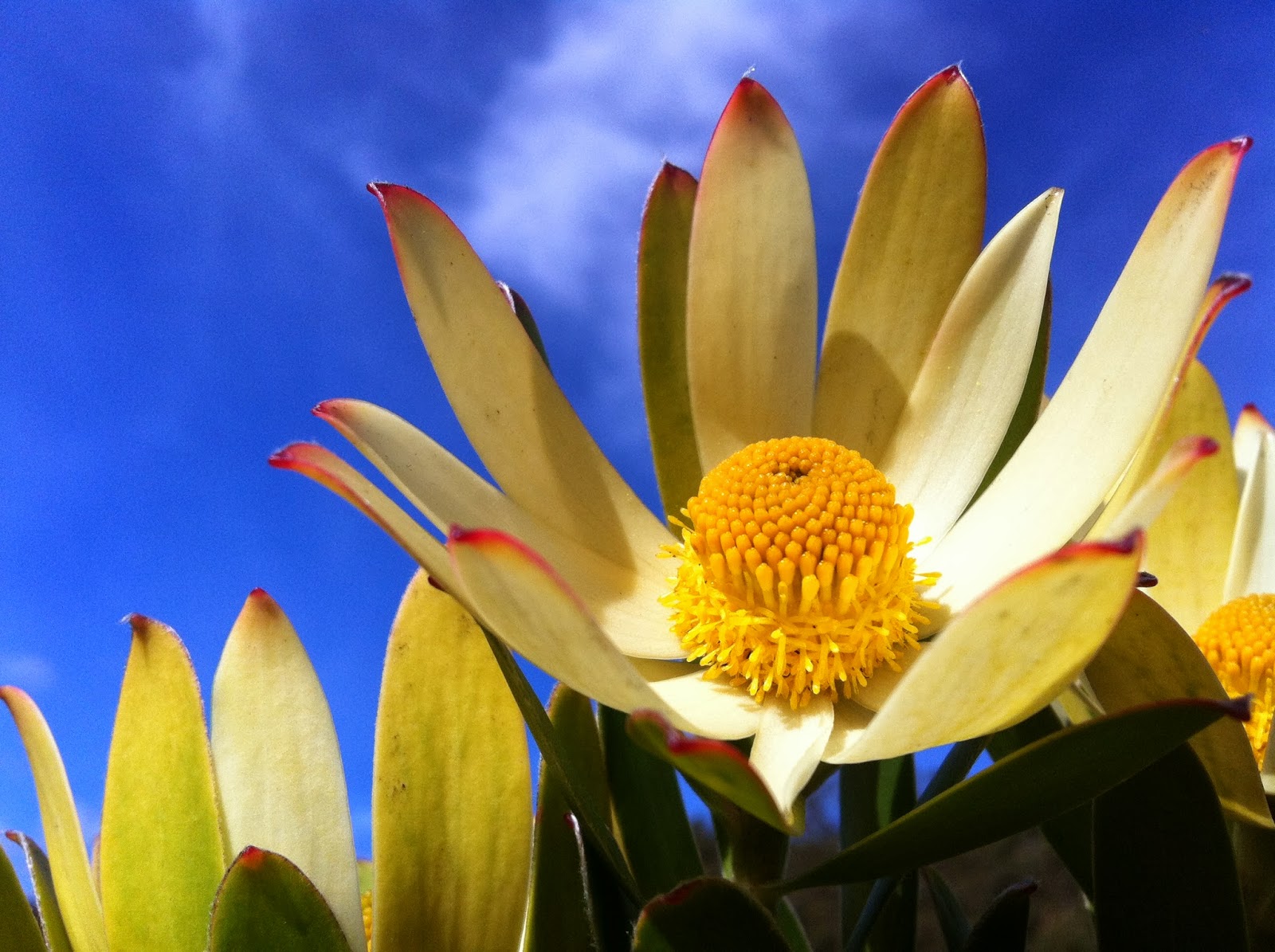
Another yellow flower available in November is the Leucadendron Pisa, which has bright yellow bracts with silvery central cones which swell as the season progresses. Towards Christmas, the swollen cones become the main focus and the bracts begin to fade to lime green.

Towards the end of November, we will often get the first flowers from the Leucospermum Mardi Gras, another yellow flower that mades a great statement. It has "ribbons" of red as the bright yellow styles emerge so creates a warm looking yellow.

The bouquet above shows lots of gorgeous November variety with the Leucospermum Mardi Gras, Waratah, Isopogon, Berzelia, Satin Mink Protea, Golden Fireworks, and Tasmanian Myrtle foliage.

For this November wedding, the colour scheme was silvery foliages and warm whites. I used a cream Protea Repens - late to be flowering in November, Berzelia berries, and creamy white Leucadendron Discolour. For foliage, I used Risdon Peppermint, Agonis Flexuosa, and L. Silver Tree. I also used Dryandra Formosa, Sea Holly, and Pimelea Nivea or Bushman's Bootlace. Some green leucadendrons were also used, with the result a leafy textured bouquet with a pared back palette.

A beautiful fragrant Silver Tree flower was the centrepiece of the bouquet. These are the male flowers from the Leucadendron Silver Tree and occur in September through to November on mature trees. They are a rare beauty.

In the bouquet above, you can see NSW Waratah, and Tasmanian Waratah teamed with Scarlet Ribbons Pincushions. The proteas included are Satin Mink and Red Compacta. Leucadendrons Maui Sunset (soft green with pink blush), Discolour (creamy white), Safari Sunset (dark burgundy) and Jubilee Crown (rosy cones). Golden Dryandra and orange Banksia Ericifolia are also used with myrtle foliage to finish it off.

For this November wedding, the theme was red, with white. These were the table decorations and included NSW Waratah, Tasmanian Waratah, Pink Ice Protea, and Banksia Coccinea. Leucadendrons Safari Sunset, Silver Tree, Discolour and Jubilee Crown were used with Berzelia berries and teamed with eucalyptus foliage.
I hope this gives some ideas of what can be achieved with native and proteaceae flowers in November - a month with incredible variety and rich colour. If you're interested in seeing some other November weddings, use the search tool on the right hand side bar and search for "November weddings".