Monday, August 27, 2012

Tall Red


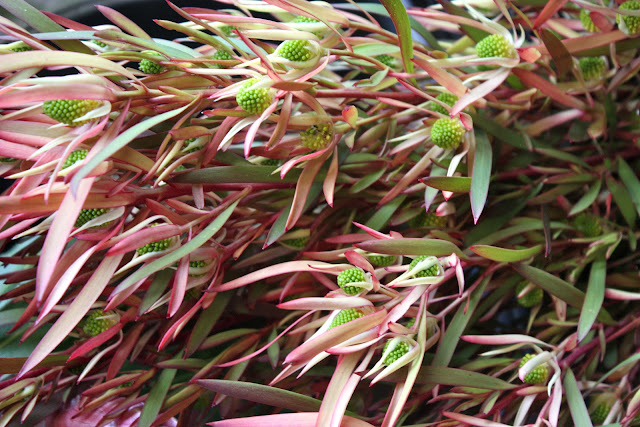
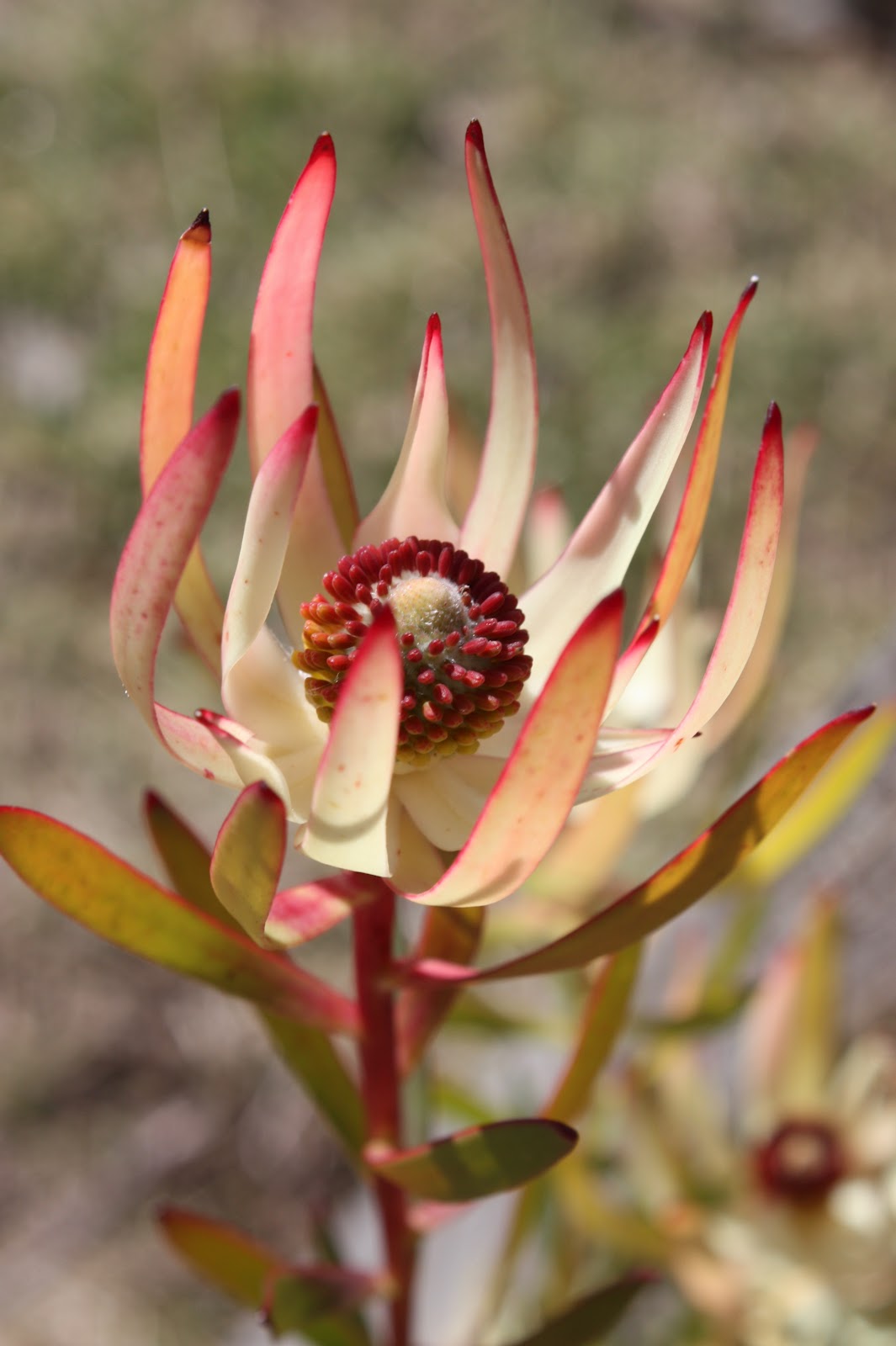
August is the month that heralds the beginning of spring colour among the Leucadendrons here at Swallows Nest Farm.  This lovely leuco is called Tall Red - an uninspired name for such a wonderful plant, I always think.  It is a selected type of Leucadendron Eucalyptifolium, which is characterised by its profuse, pointy leaves and vigorous growth habit.  It is wonderful as a foliage plant throughout the year, with a lovely red colour and long stems making it very useful.  Sometime in August, depending upon the weather conditions, it starts to sparkle and make itself much more noticeable.  The foliage changes from a rusty red to a pinky, bright red with yellow parts in the areas that get less sun.  Gorgeous lime green cones emerge.  Branches are covered in these flowers making them a beautiful textural cut flower.


In the picture above, you can see the colour variation caused by the level of sun the leaves are getting. The bracts around these cones are creamy with a pink tinge.  The more sun they receive the deeper the red colouring.  Sometimes, the colour will change along a single stem.  There are so many flower cones on each stem that the variation adds to the charm of this plant.


The cones act as pollen presenters and over a period of weeks become yellow as they "present" their pollen.  They look lovely at this stage, like little yellow pom-poms.
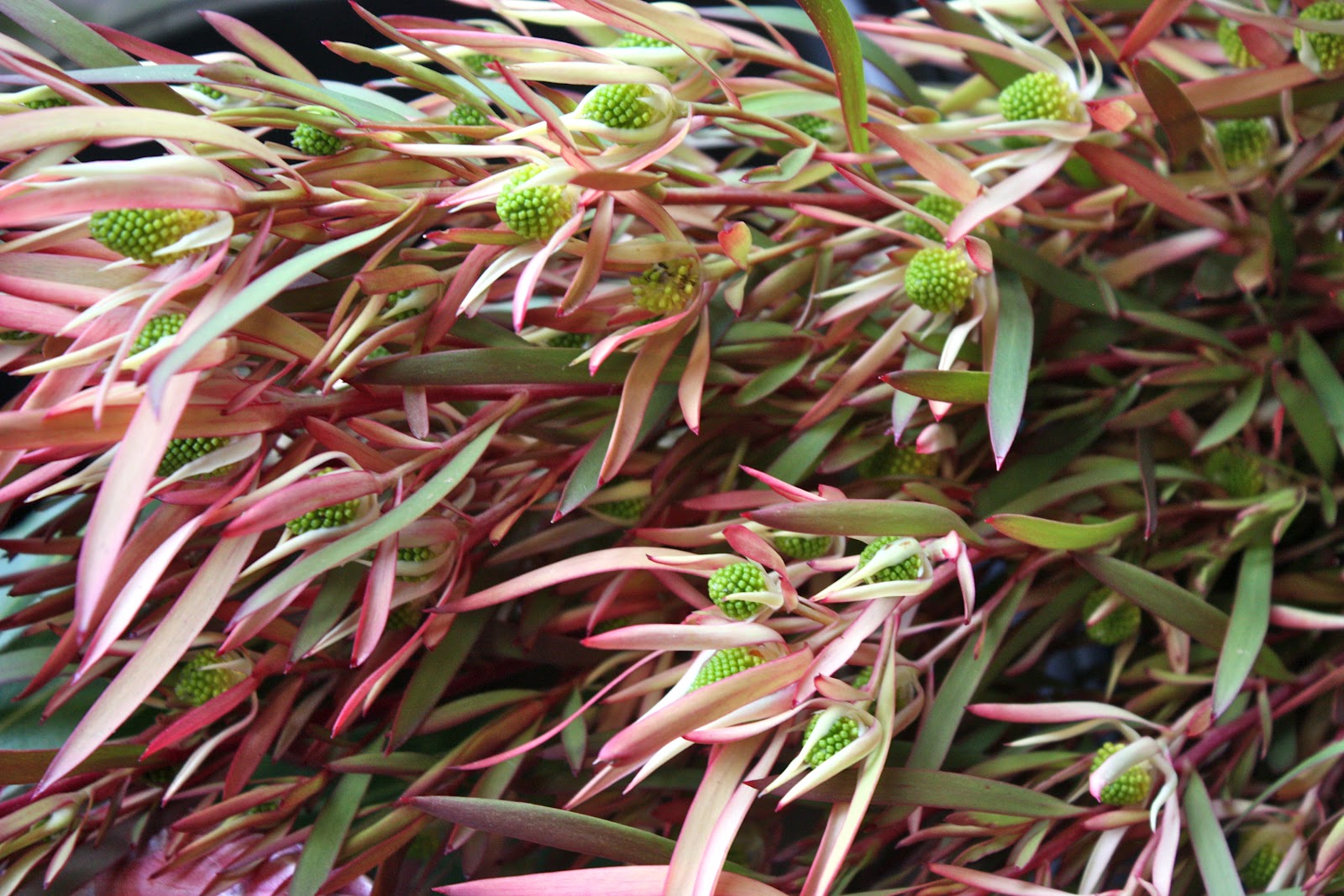

This picture shows the lime green of the cones as the stems of Tall Red wait to be put in bunches in the packing shed.  


Tall Red looks fabulous in mixed bunches at this time of the year - imagine how it would be missed in this bunch.  Even though it has lovely long stems, it can also be cut down and the flowers used in box arrangements or posies.  Its multi-flowered stems add texture and colour with a long vase life.  A truly Lovely Leuco!


Sunday, August 26, 2012

Spring is in the Air


Spring is just around the corner, and many of the plants are beginning to wake up after their winter rest.  There is a riot of colour among the many types of leucadendrons.  Over the next few weeks, I will be featuring some amazing spring flowering proteaceae but here is a sneak peek!


All of these lovely leucadendrons are late-winter or early-spring bloomers.  They create a mass of colour and texture at this time of year.  I think you'll agree that the effect is wonderfully cheery!


Saturday, August 4, 2012

Thryptomene


Thryptomene is a beautiful Australian native shrub that we grow here at Swallows Nest.  This variety is Grampians Thryptomene, found as the name suggests in the Grampians region in Victoria.  It is extensively picked in the wild there, for the cut flower trade.  We only have a small number of bushes here, but they are well established and very productive. 


In mid to late winter,  the tiny bright pink buds begin to burst into dainty little flowers that erupt between the leaves and cover the length of the branches.  They continue to flower for the next few months.  I think they have the look of snow laden branches at this time of the year.


One of the features of Thryptomene is it's beautiful aromatic smell.  Fresh, clean and foresty, it really lingers.  I love it!  


Thryptomene is long lasting as a cut flower.  It looks great as a filler in a bouquet and adds a fresh scent and a touch of authentic Australian winter.  Look out for it in florists during the cooler months!


Saturday, July 21, 2012

The Black Fringe


There are hundreds of species of Protea - and so many more when you add the lovely hybrids.  One of the most well-known traits of a Protea flower is the fringing.  At Swallows Nest Farm, we grow a small number of bushes of this lovely Protea Neriifolia, which as you can see, has a spectacular black fringe.  This pink variety reminds me of a 1950s party dress, with its bright colouring and black trim.  The Neriifolia flowers over a long period of the year, and at the moment is producing some beautiful flowers on lovely long stems.  I have had fun photographing these beauties, trying to capture their shape, colour and texture.


This is a close up of an immature flower, showing the "hairy" fringe beginning to turn black.


This photo captures a whole flower bud.  You can see that the fringing is white at this stage.  The black develops as the flower reaches maturity.


In this picture, you can see the difference between the Protea Neriifolia, and the hybrid that is the staple of the cut flower industry, the Protea Pink Ice.  The shape, arrangement of petals and black fringing are immediately apparent.  The centre mound of flower spikes differ in colour too.  


At this time of year, the pink of the proteas looks spectacular with the yellow Inca Gold Leucadendrons, and the dainty pink and white Thryptomene.  


The Protea Neriifolia are a stunning addition to a bouquet.  I really love them! 

Friday, July 20, 2012

Inca Gold


One of the leucadendrons that begins to "sparkle" at this time of the year is one called Inca Gold.  For most of the year it is a limey green with little red tips but in winter, after the solstice here in southern Tasmania, it starts to turn bright yellow.  


This picture was taken in May.  The flower heads had formed but were still slim, with more growth to come.  It's pretty at this stage with its pink stems and tiny red tips, but not spectacular.  It's good for filler in a bouquet of cut flowers.


This photo was taken mid June.  The flower heads look more plump and the stem length is good, but they are still lime green.


The Inca Gold begin to change around the beginning of July and make a fabulous contrast with the Safari Sunset Leucos.


When they reach their brightest, its easy to see why they are a winter favourite in the cut flower trade.  Spectacular cheery colour and long lasting blooms make these Inca Gold worth waiting for.


Saturday, July 7, 2012

Winter Colour


Winter has produced some beautiful blue-sky days for us lately, and today was no exception.  This stunning unedited colour (taken with the trusty iphone4) shows where this variety of leucadendron gets its name - the Safari Sunset.  As they begin to flower, the red bracts around the flower presenter change to yellow and you can see this starting to happen here.  Flowers sold at this stage are often called Tri-Colour Leucadendrons, because they turn from red to pink to yellow, like a sunset.  And with that wonderful blue backdrop, they are particularly stunning!


This leucadendron is of the variety that I most recently wrote about in Lovely Leucos part 3.  If you want to compare the colour change, click on the link.  A few short weeks ago, these Red Gem leucadendrons were a bronzey red.  Now as they start to flower, they become a warm clear yellow, with red tips.  This bright yellow will last until the flowers and pollen presenters have done their work, and then the bracts will close around the centre again and return to being red.  

Leucadendrons are such a colourful cheery plant to be growing in winter.  And at every season they provide different colour.  I'm so happy to be growing them!

Tuesday, July 3, 2012

Photos Around the Farm


I love to take photos.  I thought I'd share some of the ones I've taken lately around the farm  These first two are of an area that has been planted out in the last 12 months.  Although it looks a bit like a bunch of headstones in a graveyard, give it a couple of years and they'll be rows of productive large shrubs.  It's a very satisfying thought!  


We get a great view of Mt Wellington in the distance from this point in the plantation.


A couple of days ago I got my first ever photo (in focus, that is!!) of this wonderful Wattle Bird.  We have so many of them around the farm.  They have a very distinctive birdcall - not what you'd call pleasant, but distinctive.  And despite being quite large (maybe 40cm long) they are hard to catch on camera.  They love sitting in the Silver Tree (Leucadendron Argenteum).  They are called Wattle Birds after those dangly yellow "wattles" that hang below the eye, not as you would expect, because they like wattle!


A beautiful Silver Tree seed pod on a female tree.  


Tuesday, June 26, 2012

New Plants


I'm very excited about the arrival today of our new batch of plants.  As I've mentioned recently, winter is a great time for planting at Swallows Nest.  Last year we put in around 200 new plants.  This year, we're being very restrained - only 36!  But when they arrived today, I was so surprised by the size of them.  They were much larger and more advanced than I expected.  I can even see the beginnings of flowers on some stems, long enough to pick if and when they form properly.  I have been chasing these plants for a few years now, so there is an extra excitement at having finally been able to source some!


So what are they?  They are a type of Brunia which I have written about before.  We planted some new  Brunia last year - Brunia Albiflora which have a white flower.  These new plants are called Brunia Stokoei.  Absoloutely stunning cut flowers on long stems with beautiful architectural silvery spheres that have tiny rings of flowers - in this case pink.


We ordered the plants from a nursery in Victoria, and the horticultural transport company that brought them across Bass Strait for us wouldn't deliver them to the door, so we had to pick them up.  I'm glad there were only 36 - they were so big that they filled the entire car.  


Notice how soggy the ground is?! Great planting weather! 


This is the beginning of a flower spike, and you can see the balls starting to form.  I'm looking forward to the first flowers!!!  In the meantime, its digging holes and planting.

Please note that the first photo is not mine.  Click here to see its original home!

Sunday, June 17, 2012

Lovely Leuco's Part 3


Red Gem are a fabulous Leucadendron.  The protea books all tell you that they are unsuitable as cut flowers, because their stems aren't long enough, but here in Tassie, they are spectacular and regularly grow to 80 and 90 cm stem lengths.  These beautiful red leuco's are so versatile for so many reasons.  They have large flower bracts, tulipy in shape.  Their colour ranges from deep red, early in the season, to bronzey red, and then in winter to bright yellow, before they open to reveal their pollen presenters.  
They are a great plant to grow too - they have a special type of root system called a lignotuber, which means they can shoot stems from old wood, and even from below the ground.  In the "old days" they were regularly pruned with a chainsaw!!! I certainly wouldn't do that to them, but they do love to be pruned, and produce many new flower stems afterwards.  
We don't regularly prune our plants, but use the picking process as an opportunity to prune.  It's such a lovely job, picking these Leuco's. Not only am I rewarded with masses of lovely flowers, but i can almost hear the plants' pleasure knowing that I am also setting them up for a great crop next year.  


Wednesday, June 13, 2012

Winter Activity


Apart from picking, the main winter activity on the protea farm for us is planting.  Proteas are characterised by a special root system.  They have deep roots that anchor them, like other plants, but they also have a "proteoid" root system that is shallow and renews itself every year.  Proteas are very cyclical plants.  Winter is their root growing season, and this makes winter a good time for planting.  

Last year, we planted around 200 plants.  I'm very excited about the varieties - White Ice - a beautiful white protea with icy white "fur".  Another variety we put in is White King.  It is a type of Protea Cynaroides, the largest flowering protea with a flower the size of a dinner plate!  The white variety we planted should be a stunning flower!  It will be 3 or 4 years before we see the results though - King Proteas are slow to mature.  But it will be worth the wait!


This morning I rang a supplier about ordering some more plants for planting this winter.  I hope I am able to get the variety I'm after!  This time next year, they'll be established, and growing, and I'll hopefully be blogging about them!  I love winter!

Saturday, June 9, 2012

Welcome to Winter


Welcome to winter on the farm!  It's a little chilly, and quite wet, but its a beautiful season.  There are many proteas that flower right through the winter.  In fact, I think they are superior in some ways to the blooms produced in the warmer seasons.  They seem to be clearer and brighter, free from insect activity and the effects of strong sun.  They really glow!

Winter is also a great time for planting proteas.  We have planted in all seasons here at Swallows Nest Farm,  and by far the most successful season is winter.  The plants clearly love getting their roots into the soil when its cooler.  It gives them time to focus on their roots before they feel they have to produce leafy growth.  There is more rainfall here in winter too, so there is no need to irrigate.  Real rain always produces better results than irrigation.  Somehow, the plants can tell!

Our very first winter here, 3 1/2 years ago, we planted 50 new plants as an experiment.  We didn't really know what we were doing, but I had read up on all the varieties and then realised that I could only really buy what I could find available!  A local nursery had some of these, so in went 50 Leucadendron Safari Goldstrike.  They were so small!


We put them in the ground and never irrigated them once!  I remember that as I planted the last 3 plants,  it started to rain.  Three years later, they look like this!


This spring will be our first big harvest of these wonderful yellow Leucadendrons.  They have large teacup-like heads in bright yellow, on strong strait stems of amazing length.  Really spectacular.  I will be sure to post photos of them as they start to sparkle!