Tuesday, February 17, 2015

Native Spring Wedding Flowers


October is a brilliant month for native flowers.  A bride is spoilt for choice!  Last October I was privileged to be able to provide flowers for a wedding at MONA in Hobart.  The bride and groom were from Sydney so NSW Waratah's were a perfect choice.  My Telopea Speciosissima hybrids were just bursting with colour.  


The bride was wearing gold, so the red was really a standout colour.  I added Dryandra Formosa flowers to tie in the gold.  They are at their height in early to mid spring.  


The Dryandra leaves also add a  lovely textural quality to the bouquet.  They have a fine, zig-zag shape and fall at nice angles.


For the flower girl's bouquet, I chose some smaller waratahs to keep the size and weight manageable.   The bright pink is added by Boronia which not only creates a burst of colour, but smells divine, making it a pleasure to handle.  I used Leucadendron Lemon Spice, a selection of the female Leucadendron Discolour.  In spring its colour is spectacular, changing from a sage green to a gorgeous creamy ivory with a pink blush.  


Another ingredient I loved using for this wedding was some fresh green eucalyptus pods, immature and not ready to flower until summer.  In their immature state, they are bright green, and the textural quality adds another layer of interest to a bouquet bursting with spring goodness.  


In early October, the Berzelia or Button Bush is just ready to begin picking.  The "buttons" are green and they add another fresh textural layer to the spring native bouquet.  


One of the things I loved about this wedding was that the bride was particular about the boutonnieres.  The groom wanted white.  For the Fathers, I was given pictures of the suits and ties they were wearing, so I could create something that worked well.  It was a great way to work.  


White was a little tricky with so much colour available!  I used both wax flower and thryptomene (another duo that are fabulously perfumed) teamed with Berzelia and an immature Leucadendron Silver Tree cone.


The Silver Tree cone really glows. 


For the Fathers' boutonnieres, I used small waratahs.  I usually cull these smaller flowers, pruning them off the bushes and leaving them.  They are pretty but too small and often at odd angles so no good for selling wholesale.   I decided that they were perfect button holes for this spring wedding though - like a scaled down version of the main bouquet flowers. I like the way the red bracts surrounding the flower sit at interesting angles.


For the other boutonnieres, I used Dryandra.   These Australian Natives have a strong almost citrusy smell that can be a bit overpowering when they are first picked so I pick them a week early and sit them in the cold room till it fades a little.  They are teamed up with Lipstick Boronia and wax flower.  


Such a joyous combination of spring goodness! 
Natives are a vibrant and memorable choice for a spring wedding.


Saturday, January 31, 2015

Myrtle Beech Foliage - Nothofagus Cunninghamii

Lyell Highway Lake Burberry
I started the year with a short break to the west coast of Tasmania, my island home.  It was so nice to get away from home for a few days with the whole family.   We ate out every day for lunch and dinner, so no cooking or washing up (no small thing in a family of 7).  It was relaxing and fun and a great way to start the year.  

King River Gorge
It was also fabulous to explore parts of Tasmania that I've never been to before.  Tasmania's west coast is wild and largely uninhabited in the south which is almost entirely national park.  We stayed in Strahan midway up the west coast on the shore of Macquarie Harbour and had a great time exploring the region.  It was also a special experience for me, seeing the native vegetation in pristine temperate rainforest in the Franklin-Gordon Wild Rivers National Park. 

Gordon River
Myrtle Beech, or Nothofagus Cunninghamii, is a beautiful tree that grows in Tasmania and in southern Victoria.  I grow it here at Swallows Nest Farm for its glossy green long lasting foliage.  I have seen it growing in the wild on Mount Wellington in Hobart, but in the temperate rainforests of the west coast, it is so abundant!  Around 50% of the trees in the forest are Myrtle Beech.  

Myrtle Beech - Nothofagus Cunninghamii
Myrtle Beech is slow growing and can live up to 500 years.  In the west coast rain forests, where the Myrtle Beech are the dominant species they grow up to 40m tall with nobly wizened trunks and a dense canopy high up the tree.


The west coast area has a high yearly average rainfall - between 3 - 4 metres of rain per year.  I heard it said that there is rain in the rain gauge 330 days of the year.  That's a lot of rain!  We were so lucky to be there for 4 consecutive sunny days!


The trunks of the myrtle beech are covered in mosses and lichen.  The dense canopy of the myrtle foliage creates a perfect environment for them to flourish in the wet, deeply shadowed understory.


Myrtle Beech Foliage

The foliage of the Myrtle Beech is really pretty.  It has small glossy green leaves that grow in a fanlike shape.  As a cut foliage they have a long vase life.  
Myrtle Beech canopy
It was great to see the trees growing in their native habitat.

Hogarth Falls
Hogarth Falls is a short, simple bush walk right in Strahan village.  Our kids really loved this walk.  The myrtle towered above abundant ferns and lined the banks of the creek and the waterfall.


The tree ferns are abundant in the west coast.  They are so beautiful!

The colours of new growth
 Early summer brings new growth on our Myrtle Beech at Swallows Nest Farm.  The colours of the fresh leaves are very pretty - orange, pink and red.  

New foliage in red
The new growth is very obvious on this tree.  Unfortunately, it is no good for picking as it wilts quickly.


Once the new growth turns green though, it can be picked without fear of wilting and it lasts really well.    


 In Tasmania, you'll see fresh bunches of myrtle foliage in the local florists.  It is brilliant for use all year round, except in its new growth phase.  It's nice to know a little about this beautiful foliage and its natural habitat, the temperate rain forests of the West Coast.  

Wednesday, December 31, 2014

Tuesday, December 30, 2014

How to Make a Fresh Native Christmas Wreath


Christmas is over for another year, but my Christmas wreath is still looking good!  In the pre-christmas rush, I took a little time to photograph the steps to making a simple, native wreath.  Unfortunately, I didn't have time to blog … but better late than never, I thought I'd sneak it in before the New Year!


For this simple fresh wreath, I start with a 12" floral foam wreath.  They are available from floral supplies stores, usually under $10.  I soak the floral foam so that it is completely full of water before I begin.  


I like to begin by selecting all the materials I want to use and have them on the table around my work space.  I love to create combinations of foliage - subtle colours and textures that really give the wreath a special something!  For this wreath, I start with some sprigs of Tasmanian myrtle beech foliage.  It is really fresh at this time of year.  The new seasons growth has changed from red to rich glossy green. 
I cut sprigs the right length, and remove the leaves from the bottom few centimetres of the stem.  I cut the stems on an angle so that they are sharp and firm to press into the floral foam.  I work my way around the wreath until all the sprigs are evenly spaced.  I don't worry too much about neatness at this stage - its good to work quickly to build up the layers. 


Next, I add some fir that I've foraged from the garden.  I like the contrast between it and the myrtle beech.  I also like the structure of the fir and the way it provides a fuller look to the wreath.  It's important to remove the small needles from the stems of the fir sprigs before they are pressed into the foam, otherwise they won't hold firmly. This can be a little fiddly.   I add a small amount of  myrtle to the centre of the wreath at this stage too.  


Next, I add some sprigs of wax flower.  They add another dimension of green but also provide beautiful little highlights with the flowers that peep out.  The wax flower adds a beautiful honey scent too.  


With each layer of green, I try to balance the wreath, filling gaps and creating a nice shape but also thinking about covering the outer and inner edges of the floral foam so that they don't stand out and detract from the finished product.  


Next, I added some Leucadendron Maui Sunset.  They are a light fresh green at this time of year, with pink tips.  In this picture you can see that all the sprigs and flowers are pressed into the foam in the same direction, sweeping around the arc of the wreath.  This is important for the design of the wreath.  If things are added in different directions, the wreath can get really untidy and doesn't come together harmoniously. 


With this wreath, I decided to use just the one main flower to bring the design together.  Leucospermum Scarlet Ribbons is a great christmas flower.  The 12" wreath fits 5 of these flowers really well in s sort of star shape.  Odd numbers are generally more pleasing, visually.  4 flowers would detract from the circle shape of the wreath, making it look too square.  I cut the stems quite short, and remove all the leaves before pressing the first flower firmly into the centre of the band of floral foam. 


The placement of the 5 Leucospermums or Pincushions is quite important because they really stand out as the main feature of the design.  The first flower is placed and then the others are added carefully to create the 5 points of an invisible star. 


Adjust the flowers carefully until they are well spaced and sitting evenly. 


The final stages of the wreath involve adding the special touches and filling the gaps, adjusting until everything sings! This year I really enjoyed adding little sprigs of holly to my wreaths.  I have a holly bush that is slowly getting big enough to pick from.  Wear gloves when picking and preparing it though as it is really prickly!  Again, the springs are cut on a sharp diagonal and the bottom leaves are removed.  I press the holly sprigs into the wreath in relation to the 5 main flowers now, emphasising the design.


Another of my favourite additions to fresh native wreaths are gum nuts.  These are dried ones that I have left over from projects through the year.  They have short stems so are suited to wreaths.  Again, once those 5 main flowers have gone in, everything that is added has to be in harmony with them.   I add the gum nuts in between each flower.  I find that sprinkling them is better than placing them too neatly, because they look more natural.

In the above picture, you can also see a white rice-flower like bloom.  These are a native that grow wild on my farm and flower in summer.  I have a few different varieties, commonly known as Dolly Bush.  I am unsure if they are a Cassinia or an Ozothamnus - I think there is an overlapping there.  But if they are picked at exactly the right time, the lovely bright flower heads don't droop and and really useful to brighten up summer arrangements.  You can see a gap on the wreath where the floral foam is showing. Dolly Bush is one of the things I've used to fill in these gaps.  More little sprigs of foliage are good too.


Another of the final touches is to add Leucadendron Jubilee Crown.  These are often called "Christmas Cones" and look particularly festive.  The cheery red cones are great little highlights that add an extra dimension to the wreath.  Again, I remove all the fine needle-like leaves and cut the stems sharply before sprinkling them throughout the wreath.


Eventually, all the gaps are filled and the highlights are added.  I stand back and make sure the wreath is looking balanced.


These wreaths are lovely addition to a festive table.  Add a nice fat candle to the centre and use them as a table centrepiece.  If you remember to add a little water each day, the wreath will outlast even the typical Christmas leftovers of ham and turkey!  

I hope you all had a happy Christmas season and wish you all the best for a productive and happy New Year, with plenty of time to seek out the beauty in each day.  Thanks so much for all your support and kind comments throughout the year.

Friday, December 19, 2014

Pincushion Proteas

Spring and early summer are so busy here!  Every year I lament the fact that Christmas falls in our busy season in the Southern Hemisphere.  How nice it must be to have Christmas in the quieter months!  There are definitely some benefits of a summer Christmas though - fresh berries and stone fruit and summery tropical fruits - pavlova drenched with summer berries, long days (with daylight savings) and the long relaxing twilight, trips the beach …. ok, I take it back.  I love Christmas in summer!  But it sure is a busy time of year.  


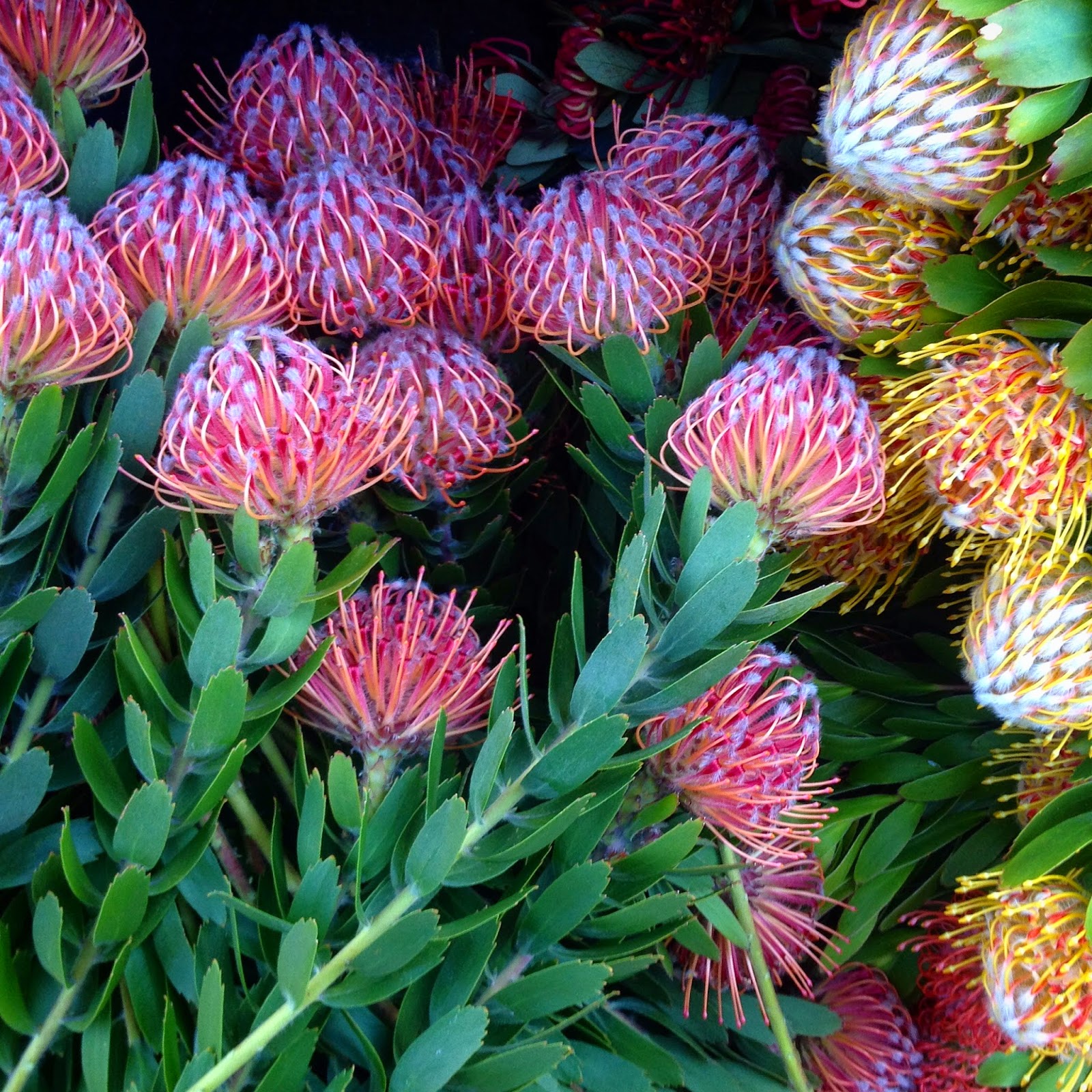
 I can't imagine Christmas time without flowers either.  Leucospermums, commonly called Pincushions are in full bloom here in late spring and into summer.  They have become synonymous with summer for me.  I am picking trailer-loads of them at the moment and so I thought I'd show off a few. 


   Leucospermums are from the Protea family.  They are a South African plant, as many proteas are, but are closely related to many Australian native plants.  The variety above is a hybrid called Mardi Gras.  The buds are silvery and hairy and are actually a composite of many tiny flowers seeming to create a single flower head.

L. Mardi Gras
As they open the colour is revealed.

L. Mardi Gras
The "pins" from which they get their common name, "pincushion",  are yellow in the Mardi Gras variety.  They emerge from the the special petal called a tepal.  When the style pops out the tepal curls inward revealing another colour, in this case bright red.  The pins begin to emerge from the outer edge of the bloom first and work their way in to the centre until all the pins are sitting out.


Pincushions flower over a relatively short period, but it is quite intense, with the bushes being covered with flowers.  


Fully grown Mardi Gras bushes are laden with flowers in early December.  


The Mardi Gras are usually the first variety to flower at Swallows Nest Farm.  They are closely followed by these gorgeous red Pincushions called Scarlet Ribbons.  I love the colouring of these flowers.


When they first begin to open, the pins are a salmon pink and the hairy tepals give a purplish tinge to the overall look of the flower.  


But as they open more, it becomes obvious why the variety was named "Scarlet Ribbons" as the inside of the tepals is a rich scarlet red.  

Fresh Wreath by Swalllows Nest Farm with Scarlet Ribbons Pincushions
Of course, this is great for Christmas time!  Leucaspermums are great in fresh wreaths.

Mixed Pincusion bunches for Christmas
Christmas bunches often look like this!  Bright summery colours.  
The next Pincushion to flower here is the orange Leucospermum Cordifolium,  with bright orange flowers and long slender stems.  

Leucospermum Cordifolium
This variety tend to flower over a more extended period of time so we get to enjoy them for longer.  I love the little yellow stigma on the end of each style, glowing like little lights.  

The Cordifolium isn't hairy like the other varieties I've mentioned, and the overall shape is more rounded.  You can see from the photo above how the Leucospermum is clearly related to some of our Australian plants from the protea family.  Grevilleas flower in much the same way, with bundles of small "flowers" arranged to create what we call the flowerhead.  And the styles and tepals are similar too.  

Grevillea


Cordifoliums are such a happy flower! Those bright yellow stigma at the end of the pins really glow don't they!

Fresh Christmas Wreath with Cordifolium, Wax Flower, Gum Nuts and Leucodendrons
I love the citrusy colour combinations that you can create with Pincushions - so fresh and summery.

Leucospermum Fountain

Our last variety to flower, beginning towards the end of December and continuing into January, is the gorgeous Leucospermum Fountain.  It's a different shape to the others, being more flattened and open.  It has a softer, subtle orange colouring but with the purplish tinge to the tepals, like the Scarlet Ribbon variety. 

Leucospermum Fountain


You can see the difference in colouring here, between the Fountain on the left, and the Cordifolium on the right (theres a Mardi Gras in the middle there too).  The softer apricot of the Fountain is really appealing and great to mix with purples, pinks and soft blue green eucalyptus foliage.  


The colour of Fountain gets richer as they age.  


Fountain can continue to flower even into February here.  I used it in a February wedding this year.  The bridesmaids were wearing apricot and the Fountains really looked great!


Pincushions, or Leucospermums are a great summer flower, and really create a summery Christmas feel.  Enjoy them when they're available!