Thursday, April 4, 2013

Tips for Longer Vase Life


Fresh flowers are one of life's little luxuries and if you're going to spend your hard earned dollar, you want to get the most for it!  Vase life is an important consideration for flower growers, wholesalers, retailers and of course, buyers.  Proteas have a reputation for being long-lived cut flowers, and they certainly are, but even the most long lived cut flowers will not last if they are not properly handled.  


As a grower, I see the flowers when they are at their absolute best - on the bush!  From the moment they are cut, they are slowly deteriorating - it's slowing down that deterioration process that makes all the difference!


BUY FRESH
My first tip is to buy the freshest flowers possible.  Buying cut flowers with a "reduced for quick sale" sticker from your local supermarket, you're not getting value for money.   It's obvious that the flowers are not going to be the freshest you can buy in this situation!  But how do you know whether the flowers you buy are fresh, or whether they have been sitting in a cold room for weeks?  It is very difficult with some types of flowers and only experience can tell.  But with proteas there are some key pointers to look for.  
1.  Colour should be clean and clear - no bruising and not dull or greyish.
2.  Leaves should be green and fresh looking (think fresh leafy vegetables).  Some proteas have a problem with their leaves blackening - this can happen even under ideal circumstances.  If you find some protea flowers that have blackened leaves but are otherwise fresh, a good trick is to remove all the leaves - this can actually be a plus with floral design, making the flowers more prominent, and making the form and colour of the flower the star of the show!


3.  Proteas open over a period of time.  As a grower, I have a window of opportunity for picking.  As soon as the petals begin to separate at the tip of the flower and are soft when gently squeezed (in the above photo) the flowers can be picked.  This differs slightly for other protea, but the principle is the same.  With waratah or pincushions, once the first few stamens have begun to emerge from the base of the flower and unfold out of the "petals", they can be picked and will continue to open.  


People often expect proteas to look like this (above) but this flower is actually too mature to pick.  Its vase life is shortened because it is already fully opened.  The central mass will start to collapse very quickly (see below) and the colour will fade.  From a growers point of view, these flowers are unsellable.  Practically too, the more open they are, they will more easily be damaged during transit. 
So for longer vase life, buy protea that have not fully opened and you'll be able to enjoy watching them unfold.  


FRESH WATER IS VITAL
This seems really obvious but I can't stress enough how important fresh water is to the vase life of a cut flower.  The following are some tips for keeping water fresh
1.  Put a teaspoon full of common household bleach into the vase before you put your flowers in.  This will stop bacteria from growing on the stems and in the water.  If you are keen, and have it on hand, a pinch of citric acid helps to pep up the flowers too.  There is no need to purchase the floral food sachets.  As a grower, I use bleach and citric acid - much cheaper than commercial water additives and every bit as effective. 
2.  Vases must be clean.  Bacteria can live on in a dry vase under the kitchen sink for months, and will seriously shorten the vase life of any flower.  The slimy, stinky water that comes from a dirty vase is not just unpleasant but will make your flowers very unhappy! Clean out dirty old vases with a bleach solution.  If you want to, you can then put them through the dishwasher every so often as the heat will kill off any lingering bacteria.  
3. If the buckets that your flowers are sitting in at the florist or wholesaler are dirty, your vase life will be lessened.  Look for clean water in buckets.  
4. When you get your flowers home, remove any leaves or slimy stems that will sit in the water.  Its a good idea to snip about 2cm off the end of stems anyway and this increases the flowers ability to "drink".  But removing leaves below the water line will also ensure that your water stays fresher for longer and that bacteria will not grow around the stems, choking off the water supply.
5.  Replenish water regularly - proteas are very thirsty flowers.  If your vase is not the see through kind, check every few days - I have seen proteas drink a vase completely dry in days.  Use a small, long necked watering can so you don't need to carry around big vases full of water.

KEEP CUT FLOWERS OUT OF THE SUN
It's common sense really, but keeping cut flowers out of the full sun will keep them fresh for longer.  Evaporation of the water is also a factor.  Tests have shown that proteas like a little fluorescent light rather than complete darkness while they are in storage.  Fluoro light is not the most flattering for showing off blooms though!  But if you keep them out of the baking sun they'll give you joy for longer.  Don't buy flowers that have been sitting in the sun at the shop - you don't know how long they've been there!


Proteas are a fabulous cut flower, long lasting, and spectacular in colour, texture and form.  If you're buying them, make sure you get value for money and buy the freshest you can and then enjoy them for longer by looking after them.  I have heard of leucadendrons being kept in a vase, with water freshened/replenished regularly, that lasted 6 months! Incredible!  

Thursday, March 21, 2013

Autumn Flush


We're well into Autumn now and we are finally getting some autumn weather.  We have had a long hot summer here in Tasmania, with some record temperatures lingering well into March.  But I think the Indian Summer has drawn to a close now, and the rain and cooler weather has arrived.  Autumn is often thought of as a season where things wind down and nature gets ready for the hibernation of winter, but here in Australia that's not the case.  We see a definite autumn flush of growth.  The Leucadendrons particularly flourish in Autumn.  Mid to late summer, they start to push out their new stems for the season and it seems that they almost grow while you watch them.  They can grow such long stems - up to 1 metre - in just a few weeks.  Above are a crop of Safari Sunset,  with their flower heads just firming up and plumping out, almost ready for picking.  


It's as if the cooler weather gives them new energy and they thrive.  New seasons growth is always so bright and clear, and the colour seems to really glow.  These are our Red Gem, just ready for harvesting now.  


These Sylvan Red Leuco's have shot up over the last few weeks but their flower heads are still small and not well formed.  If you pick them too early, their heads flop and their colour fades quickly.


There are plenty of fresh Pink Ice Protea which the bees are loving.  I found three different species of bees in this flower at the one time.


It's great to see some of our new plants flourishing with the autumn weather too.  This Leucadendron is a hybrid called Lemon Spice.  It's stems have shot up over the past couple of weeks and it seems to be reaching for the sky.  This lovely pale yellow flower with a tight tulipy shape won't be ready until spring but most of its stem length will be put on in autumn.  


These new Protea Compacta plants have doubled in height over the past couple of months.  The long stems have small flower heads hidden in the rosette of leaves at the top.  These will be lovely deep pink flowers with a rich red centre.  I'm looking forward to picking the first usable flowers from these plants this year.  We planted them as tiny tube stock coming up to 3 winters ago.  


The Thryptomene is starting to form tiny red flower buds all along its branches, ready to burst into a mass of white flowers later in the year. 
Autumn is a lovely season in Tasmania.  There are still warm days, but the air is fresh and the grass greener than in summer.  The sunsets are spectacular in autumn too.  
Stay tuned in the next few weeks for some tips on keeping cut flowers fresh for longer, and some amazing plant geometry I'm hoping to share with you.  


Sunday, March 10, 2013

My Week in Flowers


Yesterday, I did some flowers for a wedding at the Port Arthur Historic Site, a world heritage listed historic site - and probably Australia's most famous.  If you've never been there, its definitely worth a visit.  Beautiful, fascinating, and thought provoking.  The locals call it "the Site".  Until the 1980's, it was just part of the local township.  Many of the buildings that are now part of the site were once peoples homes.  It has a fascinating history and its a place I love.  I think it would be a fabulous spot for a wedding. 
These little pots were table decorations for the dining tables.  Simple seasonal Pink Ice Protea with lots of lovely foliage, including some Grevillea, Risdon Peppermint and Thryptomene (not yet in flower but with lovely red flower buds dotted along the stems).  There is also some foliage from Brunia Albiflora - the bright green soft furry stems, and the first of my leuco's for the season.  Red Gem are often my first to be ready.  They are a spectacular colour at this time of the year - new, bright and fresh.  Every year I forget what fabulous colours they can produce and they really took my breath away this week as I picked them.  They glow.


I did some larger arrangements too, but ran out of time to photograph!  Its been a busy week with earthmoving machinery, doctors appointments, orders and a wedding.  


Earlier in the week, as often happens with the floral industry, there was an order to remember the death of a loved one.  Flowers really do say it all!  
Hope you all have a great week ahead.

Sunday, March 3, 2013

What's in the Basket


I did a spot of picking for a few small orders this week, accompanied by my cat Tabitha. Tabby has been with us since she was very young, found by a forestry worker in the bush and abandoned by her wild mother.  She has always come picking with me.  Until I had her, I didn't know that cats liked to go for walks with their significant humans!  She frolics around while I pick, and talks to me every now and then.  When I'm finished, I whistle and she comes running to go home.  Just like a dog really ...
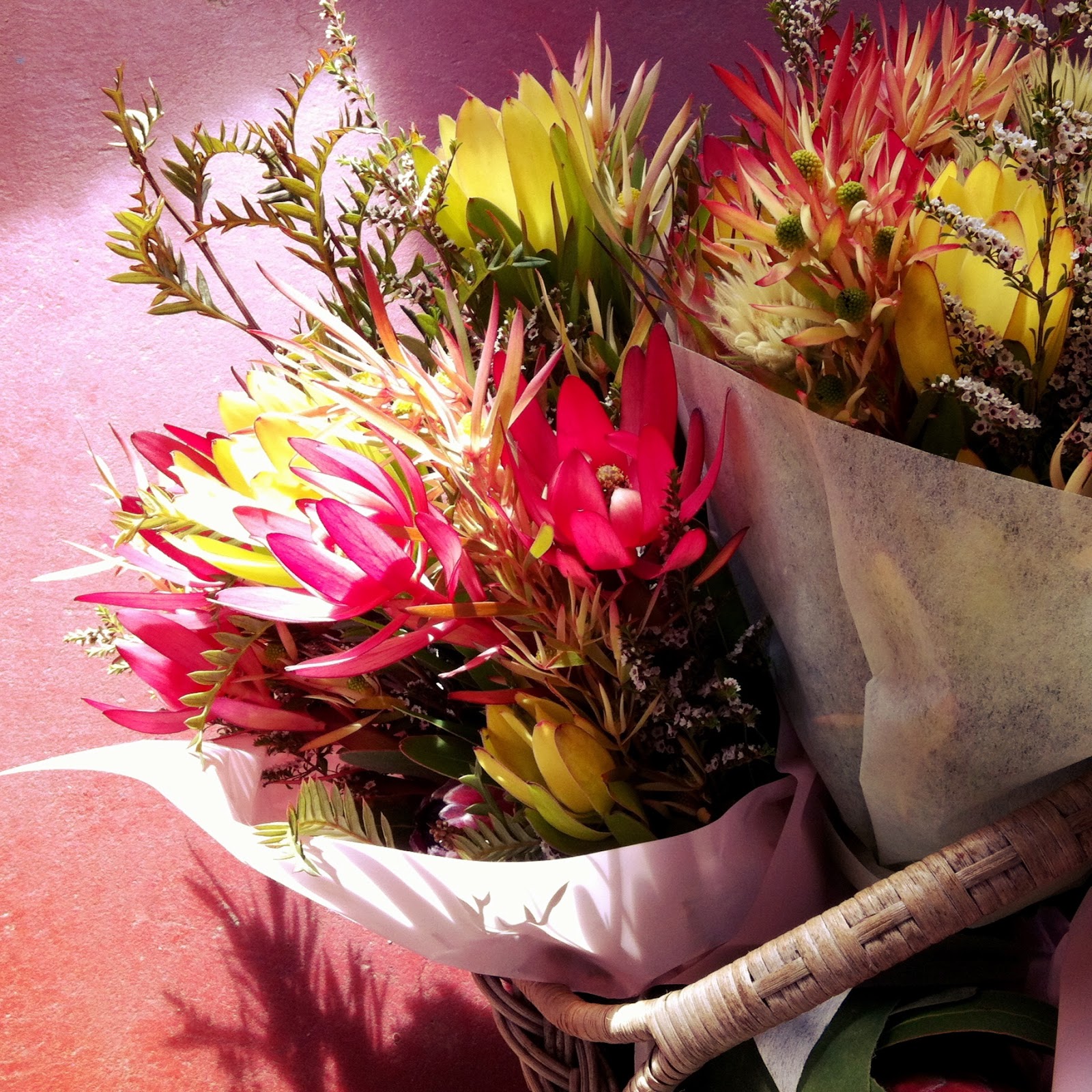
In the basket, I have some Pink Ice Protea, a lovely Banksia Occidentalis in deep red, some (hidden) new season Red Gem Leucos which seem to be a bit late this year.  The deep pinky red at the top are a plant I've only added in the last 18 mths.  They are a lovely variegated form of Leuco called Jester - rich pinky red with a central green stripe. This is the first time I've picked them to use, and while there's not enough for a commercial crop yet, they are lovely to use in small bouquet orders.  There are also some fabulous stems of eucalyptus foliage.  I'm not sure of the variety but they are a type of peppermint I think - they certainly have a similar growth habit.  The leaves are covered with that lovely greyish blue bloom that some eucalypts have, and they smell fabulous. The insects haven't found them either so they are lovely and clean.  Fun to use in a bunch adding colour and texture.  You can also see some short stems of Brunia Albiflora I've picked in readiness for a wedding this week.  They are smaller flower heads and will be great in the table arrangements in short pots.  

Wednesday, February 20, 2013

Inspirational Flowers


For a long while now, I've been trying to find time to do some lino prints of some of the flowers that I grow here at Swallows Nest.  Time gets away from me all too often.  But since the kids have all returned to school, there have been spare moments and I'm finally getting some printing done.  I'm starting with some cards, but hope to get some larger artworks done.    


I started with the most common and most numerous of the flowers we grow - the bread-and-butter blooms!  Nothing beats and red Leuco and a Pink Ice Protea.  I use oil-based printing ink and then handcolour with watercolours.  Its a challenge to get the colouring the way I like it, and then to keep it consistent as I start mass producing.  
These designs are available in my online store now at www.trees4thewood.etsy.com.  I think some different varieties of protea might be next ... 

Monday, February 18, 2013

Take a Closer Look


As you may have noticed I'm a bit of a fan of iphone photography, most likely because of convenience.   I always have my phone in my pocket, and the quality of the images you can make with it constantly surprises me.  I recently splurged on a bit of a toy - a special lense called an Olloclip that slips over the phones lense and gives you a fisheye, a wide angle and a macro lense capability.  The macro lense has been the one that has been the most fun so far.  I've been busy checking out the flowers from a completely different perspective.  The structure of the plants is quite amazing.
The first picture is a close up of the styles emerging from the base of a Banksia Baxterii.  


This picture is a closeup of the "pins" of a Pincushion flower - Leucospermum Cordifolium.  So shiny!


Banksia Occidentalis looks like a rib cage, and some tiny droplets of water have been caught.


The hairy tip of a Protea Pink Ice, just as it's ready to pick.  The white "ice" effect is created by tiny white hairs.
 

The base of the Banksia Occidentalis flower.


A closeup of the Brunia Albiflora - they look fierce!
Its been a fun exploration of the flowers as I haven't seen them before.  

Monday, February 4, 2013

What's in the Basket


I picked the first Banksia Baxterii for the summer last week.  In the basket was a selection for some birthday bunches.  There are some late Leucaspermum Cordifolium, bright orange and cheery.  There are also some fresh Protea Pink Ice.  Over Christmas is the only time of year that its hard to get these pink beauties - there are about 3 weeks where they are few and far between.  But they are now returning to bloom.  There is some lovely Tasmanian Myrtle foliage there too - Nothofagus Cuninghamii.  You can also see some Brunia Albiflora in the basket - at its peak of production at the moment, and one of my personal favourites.  

Saturday, January 26, 2013

Its 2013


What a busy start to the new year.  I have hardly had time to catch my breath let alone blog.  Summer in Tasmania is always full of surprises.  Whether it's snow falling on the peaks, or thunder storms, or baking sun, you have to be prepared for anything.  This year, 4th January was the hottest recorded day in Tasmania for 130 years.  It also saw a major bush fire disaster begin that was to last for more than a week.  Swallows Nest Farm is situated on the Tasman Peninsula - almost an island in itself except for a narrow strip of land that joins it to the mainland of Tasmania.  The fires cut off access to the peninsula and we were unexpectedly separated from our home and two of our kids.  We spent almost a week away from home, staying with our friends at South Arm, before we were able to return home in a police escorted convoy.  What an experience!  We were so pleased to get home and find all our animals and all the proteas safe and sound, if a little ashy and dry!
Bushfires are a part of life in the Australian bush.  There is a cycle of life in which fire plays an essential role.  Many native plant species only reproduce naturally after a fire.  Proteaceae are among those plants that are adapted fire as a way of reproducing or regenerating.  Seeing the devastation so close at hand it is hard to imagine it ever being green again, but with the first spots of rain, some of the green shoots are already beginning to peep through the blackened soil. Banksias growing by the beach will open their cones and eject seed ready to germinate.  Some plants will shoot from root systems below the ground.  I'm looking forward to seeing this regeneration.


Life cycles are integral to life as a flower grower.  Summer will soon turn to autumn and then winter.  I will stop writing 2012 instead of 2013 and we will be well into the busyness of the year.  I'm looking forward to the cycle, as the plants produce their blooms and I'm looking forward to watching the renewal of the the bushfire affected landscape.  I hope that 2013 brings renewal and growth and plenty of blooms for you too!

Saturday, December 15, 2012

Christmas Cones


Some Leucadendrons are grown not for their flowers but for the cones that appear after the flower.  This hybrid Leucadendron Jubilee Crown is one of them.  It is often called Christmas Cones because it produces these lovely blushing red cones in December, just in time for Christmas.  


The flowers of the Christmas Cone bush are pretty but not really memorable.  After the flowers are spent, the centre starts to swell and a cone forms.  It swells and as it does, its colour becomes more vibrant until it is round and rosie red and ready for picking.  The bush produces lovely straight stems which get longer with good rainfall.  


Christmas Cones are fabulous in a Christmas bunch - their colour and texture lend themselves well to seasonal arrangements.  They are long lasting too, like most Leucadendrons, and will usually be the freshest looking flower in the bunch, after all the others are spent.  


After the cones are spent, they open and dry out, and resemble tiny pinecones.  Last years cones remain on the bush.  They are generally not sold at this stage, but I think they still look lovely and can be used in floral arrangements even as a "dead" or spent flower.  


Leucadendron Jubilee Crown, "Christmas Cones", is not the main event in an arrangement but it is certainly a valuable addition to a Christmas arrangement adding a charming texture and colour.   

Monday, December 10, 2012

The Christmas Rush


I sometimes wonder what it would be like to have Christmas in winter.  Summer is such a busy season here.  There is so much to do around the farm - the grass seems to grow while you watch it.  The leucaspermums all seems to flower at once, and everyone wants flowers for Christmas.  Add to all this the normal end of year activities and you end up with a great long list of things that need to be done!  But in amongst it all, there are some fun jobs.  I've been designing christmas arrangements and wreaths and I love the creative side of it. 

The potted arrangement above has three types of Leucosermum - Cordifolium (the orange one) Scarlet Ribbons (the red) and Mardi Gras (the yellow and orange).  I've also included some Berzelia or button bush - the creamy white little pom poms, and a selection of leucadendrons.  


This Christmas wreath includes our newest planting of leucaspermums - Scarlet Ribbons.  They've been in the ground just over 2 years and we've had a great crop of them this year.  They are a relatively early flowering variety for us, and they look so cheery on the hillside where they grow.  I love the way they change colour from pink and greyish purple and red when they are just opening, to rich red with orange and tinges of pink as they mature.  

The wreath also has our leucadendron Christmas Cones - the little purplish red cones that you can see peeping out of the foliage.  They are such a great Christmas time plant.  The beautiful swelling cones are so vibrant on the end of the stems, and even look good when they are aged and dry.  They end up looking like miniature pinecones on the end of the stems.  What a useful Christmas plant!!  

I have added some of our Tasmanian Myrtle foliage too, which is looking so spectacular after its growth season in spring.  It's botanical name is Nothofagus Cunninghamii.  It is a beautiful Tasmanian tree that is highly prized for its pinkish toned timber which makes wonderful furniture and wood products.  I love to pick it, because it has a wonderful resinous smell that lingers on your hands. 
You might also be able to see some Geraldton Wax flowers, and some Eucalyptus foliage.  I just love the way the colours and textures of the different plants blend together when I'm creating different bunches and arrangements. 

I think sometimes the busyness of the season can get the creative juices flowing!


Sunday, November 18, 2012

Summer Colours


Summer is within reach!  The days are longer and warmer and the first early summer flowering Leucaspermums are starting to bloom.  Leucaspermums are a species of plants within the Protea family.  They are native to South Africa, although here in Australia they are often called "natives".  They do resemble a lot of our Australian Proteaceae - they seem like a cross between a waratah and a grevillea, with a great variety of colours.  Leucaspermums usually flower in late spring and early summer.  Here at Swallows Nest Farm, we have 5 different varieties.  The one pictured is a hybrid called Mardi Gras with bright yellow stamens and red inner petals that give an overall colour of golden yellow.  


In bud form, they are silvery and hairy.  Then the bud starts to swell and out pop the stamens exposing both the yellow and the red.  It's an explosion of colour!


Mardi Gras are one of the earlier flowering Leucaspermums that we grow here.  The other is called Scarlet Ribbons.  These two are available from mid November up until Christmas, give or take a week depending on the seasonal weather.  These plants produce a large crop of flowers in a short space of time.  


Leucaspermums are long lasting flowers like most proteas, if they are handled correctly.  They must be packed carefully though, because they have a tendency to loose their heads!  The flower can easily pop off the stem if they are handled roughly.


Leucaspermums love to be pruned and will produce many more flowers next year, if this years flowers are picked.  They are ready to pick when the first yellow stamens start to emerge.  They will continue to open once they are in a vase.


I love this early flowering variety that has the colours of summer!

Monday, November 12, 2012

In Full Bloom


Spring is coming to an end, and the Tasmanian Waratahs are in full bloom.  The smell of summer is in the air!  Many of the spring flowering leucadendrons are starting to loose their colour now and the summer flowering proteas are getting ready to make their appearance.  Watch out in the next week or so for the bright and beautiful Leucaspermums, commonly known as pincushions, that are popular coming into Christmas.  


I'll be posting about the amazing varieties of pincushions that we have here at Swallows Nest Farm as they begin to flower.  In the meantime, enjoy the last of spring and its spectacular colour!


Tuesday, November 6, 2012

What's in the Basket?


We've been at Swallows Nest Farm for 4 years, and not long after we arrived, I found a basket at a local op shop which said "BUY ME"!  It has become my constant companion on the farm.  I use it for everything from planting to pruning to picking and even delivering bunches.  When we are picking large wholesale quantities collecting into a trailer attached to a small tractor, I always have my trusty basket to take the flowers to the tractor.  

Boronia Heterophylla, Leucadendron Lemon Spice, Grampians Thryptomene, Berzelia Button Bush


Every now and again, I look down at the basket and admire its contents.  Then, I'll whip out the iphone and snap off a photo. 

Isopogon Formosa Pink Cone Flower, Red Gem Leucadendron, Berzelia Button Bush

I have quite a collection of these basket photos now, and have decided to start a regular (or irregular!) post on the blog called "What's in the Basket?"  This will be the first of many so you get a kind of overview - a Year in a Basket!

Leucadendrons Maui Sunset, Safari Sunset, Inca Gold, Tall Red, Safari Gold Strike and Protea Neriifolia 

The basket is quite large but sometimes it gets overloaded - the flowers in the photo above make it look so small!

Grampians Thryptomene, Richea Dracophylla, Berzelia Button Bush, Telopea Speciosissima Waratah

Retail bunches ready for delivery to a local shop.

I'm looking forward to sharing what's in my basket. I hope you enjoy taking a peek!