Friday, September 21, 2012

Maui Sunset


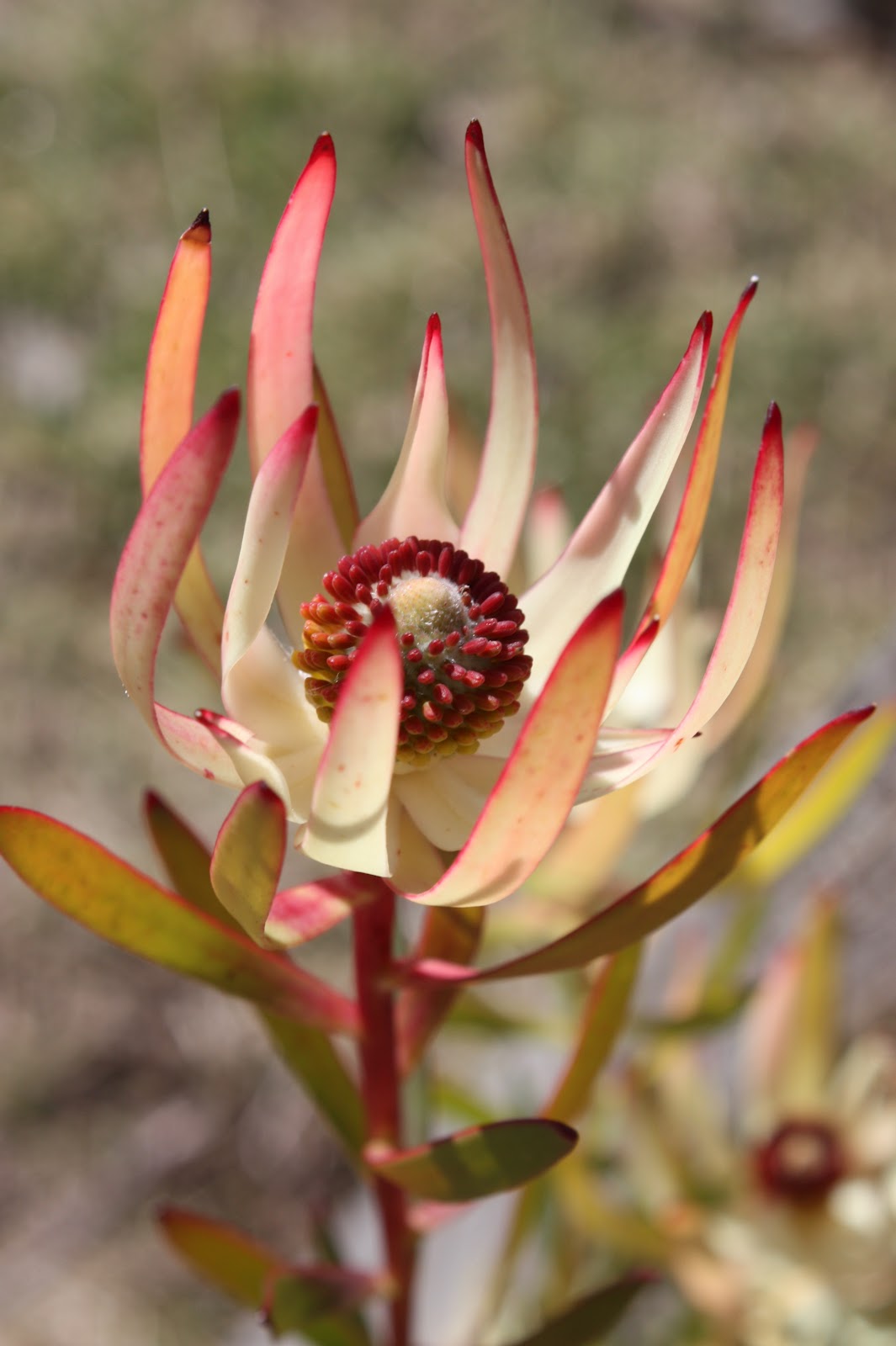
The next spring flowering Leucadendron I'm featuring this year is this gorgeous blushing beauty called Maui Sunset.  It's creamy white bracts are tinged with delicate pink and the shape is almost rose-like.  For most of the year, Maui Sunset is a fairly unremarkable green.  


There is a tinge of brownish pink, but its not what you'd call a "stand-out" colour.  Over winter, the pinkish tinge begins to increase, and the green slowly starts to lighten. 


By late winter, these lovely leuco's have thrown off their cloak of invisibility and are definitely beginning to shout "look at me"!  But they continue to lighten until they are almost white, glowing, and rimmed with pink.  The ridge along the top of the hill where they grow is transformed.


Maui Sunset are not widely found in florists.  They don't have the same long stems that other leuco's have.  I think the colour and beauty of them make up for the shorter stems!  We often leave some of our bushes uncut and allow them to grow two seasons, giving them a multi headed stem with longer length.    Then, they are really useful in larger bunches.  


The Maui Sunset on top of the basket above show how this second years growth give the effect of many flowers on one stem.  I picked 6 or 7 stems here, and each stem had 3 or 4 flowers on it.  


The spectacular colour transformation of these Maui Sunset are a very obvious sign of the change of season around the farm, and their effect is so cheery and bright - they are definitely a spectacular spring flowering Leucadendron.  


Saturday, September 15, 2012

The Waratah's Are Out


Today, I picked my first Waratah of the season.  What a stunning flower, the Waratah is.  It is an Australian Native, and the floral emblem of New South Wales.  We grow a number of different Waratah or Telopea hybrids at Swallows Nest.  They are characterised by their long (up to 1 metre) strait stems, and large red showy flowers that are long lasting.  


The Waratah is from the Proteaceae family and grows from a lignotuber, a swelling in the root crown that acts as a protection from fire.  The plant stores nutrients and buds in the lignotuber, and can sprout from below ground level.  Because of this, cutting the flowers of a Waratah encourage more stems to sprout until you get a very bushy plant with many many stems.  Some cut flower growers have very prolific plants producing up to 400 stems each, in a season.  Ours are not quite up to that yet, but we are working on it!  


Over summer the plant focuses on producing stems.  Each stem forms a single bud.  Then over late winter the bud begins to swell.  


Over a period of weeks, they begin to open and reveal the flower.  Waratahs seems to slowly unpack themselves in stages.  The outer "petals" are actually modified leaves called bracts.  Inside the bracts are many small flowers arranged in a dome shape to form what we think of as the Waratah flower.  These individual little flowers seem to unfold and arrange themselves in the recognisable domed shape before they start to actually open.  


You can see in the picture above how the little flowerets begin to open at the outside and work their way to the middle of the dome.  

A tip for buying or picking Waratahs is to select ones that have just begun to open their little flowerets.  This will usually start on the sunny side of the plant.  Once a few of styles are open, they are ready to pick.  This will give them a much longer vase-life.  When buying Waratahs, look for ones that are not completely open.  This will give you longer to enjoy them.


At Swallows Nest Farm, we have a number of different varieties of hybrid Waratahs.  The first flowers usually appear in early September, and later flowering varieties keep appearing until mid to late December. We have some beautiful white ones too, which I'll feature when they start to flower in a few weeks.  

These popular flowers are a wonderful bold statement that spring is here!


Monday, September 10, 2012

Flower Show Time


Spring is Flower Show time in Tasmania and our District School hosts our local flower show.   I  have always felt that, as a local flower grower, I really should be involved in a local flower show! But because of various reasons beyond my control, I have never actually been to see our local show until this year.  I was also able to be involved, by donating a few bunches for fund raising.  


I had fun doing a quick pick, mostly of the vibrantly coloured spring flowering Leucos.  I probably should have taken the trailer, because my poor old faithful picking basket got so over-full that I nearly broke it!


Simple bunches of Leucadendrons in cheap and cheerful plastic wrap were snapped up.  I also did simple bunches of Protea Neriifolia, which are looking particularly fabulous at the moment.  They all sold out before I got to the show.  

I had a lovely time looking at the Daffodil exhibits, with some amazing variations that I've never seen before. 


 There were also some stunning floral arrangements.  Having checked out the competition, so to speak, I'm considering entering an arrangement in next years flower show!  I'm sure you'll hear all about it when it do!

Sunday, September 2, 2012

We've Struck Gold


Please excuse the cheesy title of this post, but this beautiful spring flowering leucadendron is called Safari Goldstrike.  I wrote about it earlier in the year.  It was our first new planting after we took over the protea farm 4 years ago, and it has been a great success.  This year is the first big harvest, with the plants beginning to produce lots of saleable stems.  If you want to see the before and after shots, click on the link.


For most of the year, Safari Goldstrike are a green leaucadendron with a slightly pink tip, as seen in the photo above.  Many florists use them at this stage.  They are long lasting and a great accent flower, the green really glowing among soft pastels, or natives. 


You can see them being used above in this native arrangement.  Depending upon the weather conditions, sometime in August these unassuming leuco's decide its their time to shine, and they begin to change colour and open into the large golden blooms that give them their name.  


They really glow with colour and their large, teacup shaped flowers just shout "look at me".  


We are so proud of these great flowers - our first planting.  They are versatile all year round, but are definitely a spectacular spring-flowering leucadendron.

Thursday, August 30, 2012

Truly Tasmanian - The Pineapple Candle Heath


Meet the Pineapple Candle Heath, or Richea Dracaphylla,  a truly Tasmanian flower.  When I first discovered this plant, I thought it looked like it should be a tropical bloom - some type of rainforest rarity that could be feasted on by colorful tropical birds.  But its home is the temperate rainforest slopes of Mount Wellington and other high altitude rainforests - moist and cold, the soil wet with snow-melt and a dense canopy of trees over head.  It is endemic or native to Tasmania.  These flowers have been harvested in the wild, but at Swallows Nest we have some wonderful well established plants that are able to be pruned and trained to produce lovely long stems.  


Pruning these plants is no mean feat!  They are as spiky as they look and very dense.  Gloves are required!  But the effort is worth it when the lovely long stems produce beautiful tall flower spikes.  Flowering time is usually the spring months but we often get flowers here much earlier - July and August.  Flowers can also surprise us at other times of the year, but August is usually when they are really starting to bloom in earnest.   


The spiky leaves, about 20cm long, spiral up the stem and the flower emerges from the crown of the spiral.  These flowers are sometimes called Riceflower, because of the obvious likeness.   The rice-looking part is actually the petals of the flower that are fused together.  They fall off when the stamen in mature.  These petals are grouped together and sheathed by bracts that often carry a pink or red tinge.  


In this picture, you can just see the flower starting to emerge from the spiral of leaves on the stem.  


In this picture, you can see how the bracts surround the petals.  There are some petals peeping out on the left.  The bract will open and eventually fall off.


Richea Dracophylla, or Pineapple Candle Heath are a very architectural flower - a strong bold shape.  But they can also be softened by adding them to other natives.  They are a beautiful and unusual flower - uniquely Tasmanian.  

Monday, August 27, 2012

Tall Red


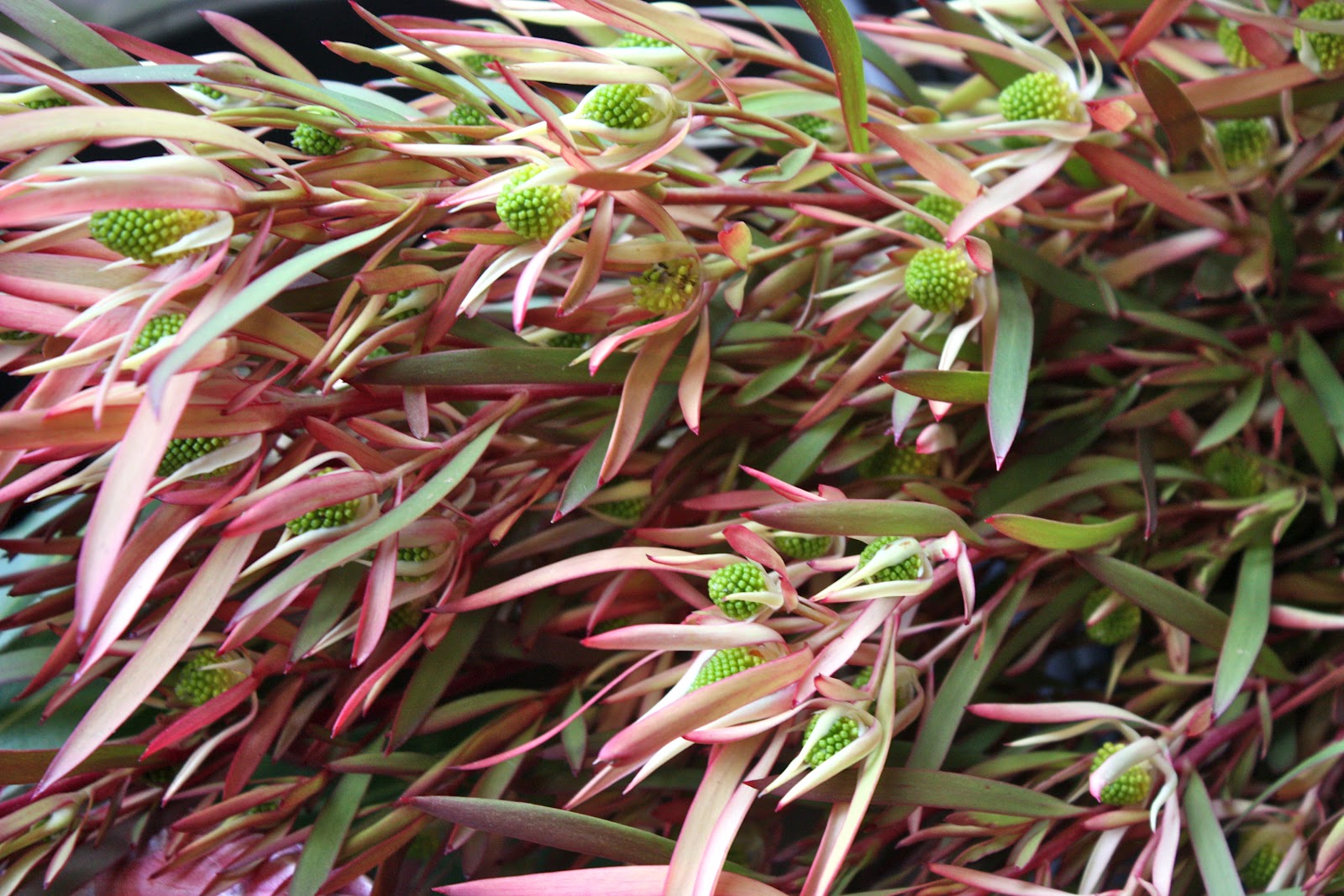
August is the month that heralds the beginning of spring colour among the Leucadendrons here at Swallows Nest Farm.  This lovely leuco is called Tall Red - an uninspired name for such a wonderful plant, I always think.  It is a selected type of Leucadendron Eucalyptifolium, which is characterised by its profuse, pointy leaves and vigorous growth habit.  It is wonderful as a foliage plant throughout the year, with a lovely red colour and long stems making it very useful.  Sometime in August, depending upon the weather conditions, it starts to sparkle and make itself much more noticeable.  The foliage changes from a rusty red to a pinky, bright red with yellow parts in the areas that get less sun.  Gorgeous lime green cones emerge.  Branches are covered in these flowers making them a beautiful textural cut flower.


In the picture above, you can see the colour variation caused by the level of sun the leaves are getting. The bracts around these cones are creamy with a pink tinge.  The more sun they receive the deeper the red colouring.  Sometimes, the colour will change along a single stem.  There are so many flower cones on each stem that the variation adds to the charm of this plant.


The cones act as pollen presenters and over a period of weeks become yellow as they "present" their pollen.  They look lovely at this stage, like little yellow pom-poms.


This picture shows the lime green of the cones as the stems of Tall Red wait to be put in bunches in the packing shed.  


Tall Red looks fabulous in mixed bunches at this time of the year - imagine how it would be missed in this bunch.  Even though it has lovely long stems, it can also be cut down and the flowers used in box arrangements or posies.  Its multi-flowered stems add texture and colour with a long vase life.  A truly Lovely Leuco!


Sunday, August 26, 2012

Spring is in the Air


Spring is just around the corner, and many of the plants are beginning to wake up after their winter rest.  There is a riot of colour among the many types of leucadendrons.  Over the next few weeks, I will be featuring some amazing spring flowering proteaceae but here is a sneak peek!


All of these lovely leucadendrons are late-winter or early-spring bloomers.  They create a mass of colour and texture at this time of year.  I think you'll agree that the effect is wonderfully cheery!


Saturday, August 4, 2012

Thryptomene


Thryptomene is a beautiful Australian native shrub that we grow here at Swallows Nest.  This variety is Grampians Thryptomene, found as the name suggests in the Grampians region in Victoria.  It is extensively picked in the wild there, for the cut flower trade.  We only have a small number of bushes here, but they are well established and very productive. 


In mid to late winter,  the tiny bright pink buds begin to burst into dainty little flowers that erupt between the leaves and cover the length of the branches.  They continue to flower for the next few months.  I think they have the look of snow laden branches at this time of the year.


One of the features of Thryptomene is it's beautiful aromatic smell.  Fresh, clean and foresty, it really lingers.  I love it!  


Thryptomene is long lasting as a cut flower.  It looks great as a filler in a bouquet and adds a fresh scent and a touch of authentic Australian winter.  Look out for it in florists during the cooler months!